One of the first questions businesses ask after starting SEO Services is, “How long does…
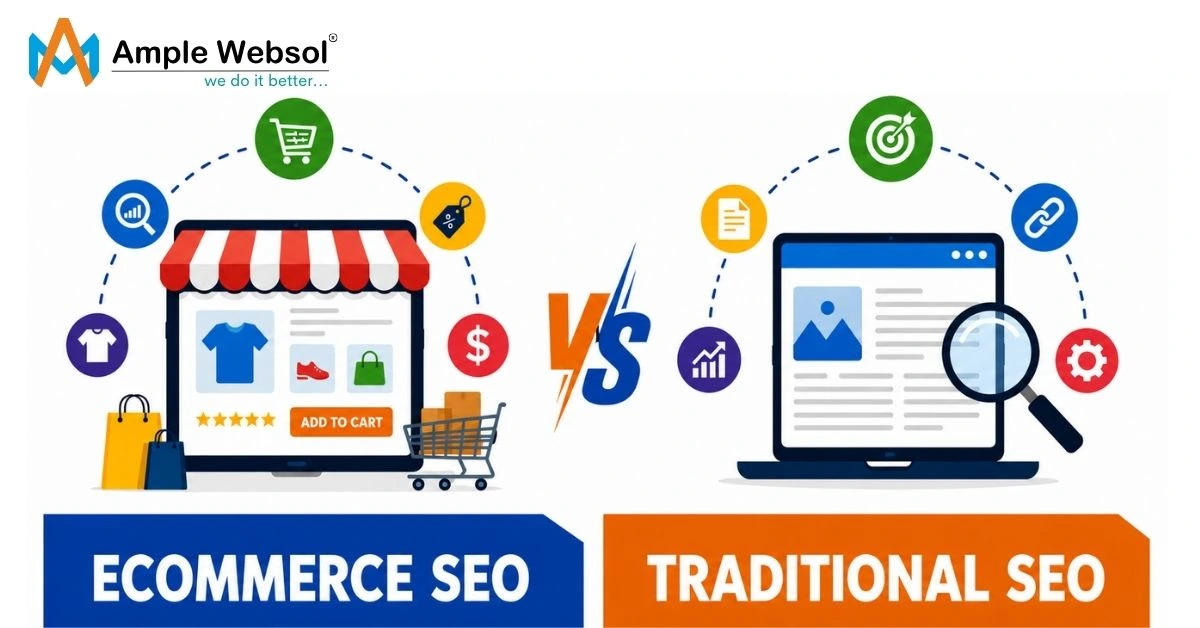
SEO helps businesses improve their visibility on Google and attract customers through organic search. However, Ecommerce SEO and Traditional SEO require different approaches because online stores have unique challenges such as product pages, categories, filters, reviews, inventory, and large website structures.
So, Ecommerce SEO vs Traditional SEO—which is better? The answer depends on your business model, website size, products, customers, and goals. Traditional SEO works well for service-based and informational websites, while Ecommerce SEO is designed specifically to improve the visibility and sales of online stores.
Table of Contents
hide
What Is Ecommerce SEO?
Ecommerce SEO is the process of optimizing an online store to improve its visibility in search engines and attract potential buyers.
Unlike general SEO, Ecommerce SEO focuses heavily on product and category pages. The goal is not only to generate traffic but also to bring visitors who are ready to compare products, make purchases, or take other commercial actions.
A strong Ecommerce SEO strategy typically includes:
- Product page optimization
- Category page optimization
- Ecommerce keyword research
- Technical SEO
- Internal linking
- Product schema
- Image SEO
- Website speed optimization
- Mobile optimization
- Content marketing
- Link building
What Is Traditional SEO?
Traditional SEO generally refers to optimizing websites to improve their organic search visibility across informational, local, and commercial searches.
It is commonly used by:
- Service businesses
- Local businesses
- B2B companies
- Professional firms
- Blogs
- Corporate websites
- Educational websites
Traditional SEO usually focuses on service pages, landing pages, blogs, location pages, and other informational or commercial content.
Ecommerce SEO vs Traditional SEO
The biggest difference is what the website is trying to achieve.
| Factor | Ecommerce SEO | Traditional SEO |
| Main Goal | Increase product visibility and sales | Increase visibility, traffic, leads, or brand awareness |
| Main Pages | Products and categories | Services, blogs, landing pages |
| Search Intent | Strong commercial and transactional intent | Informational, commercial, and local intent |
| Keyword Strategy | Product, category, brand, and buying keywords | Service, informational, local, and commercial keywords |
| Schema | Product, Offer, Review, Breadcrumb | Organization, Local Business, Article, FAQ, Breadcrumb |
| Internal Linking | Products, categories, collections | Services, blogs, resources, landing pages |
| Conversion | Purchases | Leads, calls, forms, sign-ups |
| Technical Challenges | Filters, variants, inventory, duplicate URLs | Crawlability, speed, structure, content |
| Content Strategy | Buying guides, product content, comparisons | Blogs, guides, service content, resources |
| Best For | Online stores | Most non-ecommerce websites |
Ecommerce Keyword Research vs Traditional Keyword Research
Keyword research is important for both strategies, but the search intent can be different.
Ecommerce SEO Keywords
Ecommerce websites often target keywords with buying intent, such as:
- Buy running shoes online
- Best office chairs
- Women’s winter jackets
- Stainless steel water bottles
- Buy ergonomic office chairs
These searches indicate that the user may be close to making a purchase.
Want more traffic, better Google rankings, and higher sales? Contact Us today for expert Ecommerce SEO Services and a strategy built around your business goals.
Traditional SEO Keywords
A service-based website may target searches such as:
- What is technical SEO?
- SEO services for small businesses
- Website development company
- How does Google SEO work?
- Best SEO strategy for startups
The goal may be to educate the visitor first and convert them later.
Common Ecommerce SEO Mistakes
Ecommerce websites should avoid common SEO problems such as:
- Duplicate product descriptions
- Thin category pages
- Missing product schema
- Slow product pages
- Poor mobile experience
- Broken product links
- Incorrect canonical tags
- Indexing unnecessary filter URLs
- Missing image alt text
- Poor internal linking
- Ignoring out-of-stock products
Regular Ecommerce SEO audits can help identify and fix these issues.
Common Traditional SEO Mistakes
Traditional websites can also lose visibility due to:
- Targeting the wrong keywords
- Creating thin content
- Keyword stuffing
- Weak internal linking
- Poor website structure
- Ignoring search intent
- Slow page speed
- Missing metadata
- Poor mobile optimization
- Not updating outdated content
SEO should be treated as an ongoing process rather than a one-time activity.
Can Ecommerce SEO and Traditional SEO Work Together?
Yes. Many businesses can benefit from using principles from both approaches.
For example, an ecommerce company can combine:
Ecommerce SEO
- Product optimization
- Category SEO
- Technical SEO
- Product schema
Traditional SEO
- Blogs
- Buying guides
- Educational content
- Industry resources
- Link building
This creates a more complete SEO strategy that can attract customers at different stages of the buying journey.
Which Is Better for Your Business?
Use the following comparison to choose the right approach:
| If Your Business… | Recommended SEO |
| Sells products online | Ecommerce SEO |
| Has thousands of products | Ecommerce SEO |
| Needs more online sales | Ecommerce SEO |
| Generates leads through services | Traditional SEO |
| Publishes informational content | Traditional SEO |
| Is a local service business | Traditional + Local SEO |
| Has an ecommerce store and blog | Ecommerce + Traditional SEO |
| Has a large marketplace | Ecommerce + Programmatic SEO |
For online stores, Ecommerce SEO should be the primary strategy, while traditional SEO techniques can support content marketing and authority building.
Ecommerce SEO vs Traditional SEO: Which Is Better?
There is no single answer for every business.
Ecommerce SEO is better for online stores because it is specifically designed around products, categories, shopping searches, and online conversions.
Traditional SEO is better for service-based and informational websites where the primary goals are rankings, traffic, leads, and brand visibility.
For ecommerce businesses, the strongest approach is to combine Ecommerce SEO, Technical SEO, Content Marketing, and Traditional SEO principles. This creates a complete strategy that can improve visibility, attract qualified shoppers, and increase online revenue.
Frequently Asked Questions
Ecommerce SEO focuses on optimizing online stores, products, and categories to generate sales. Traditional SEO is broader and is commonly used for service, informational, corporate, and local websites to generate traffic, leads, and visibility.
Ecommerce SEO can be more technically complex because large online stores have products, variations, filters, inventory changes, and many URLs. However, both require strong keyword research, quality content, technical SEO, and continuous optimization.
Yes. Shopify stores can benefit from Ecommerce SEO through optimized product pages, category pages, content, internal links, technical improvements, and structured data.
Yes. Ecommerce websites can use traditional SEO techniques such as blogging, content marketing, link building, and educational content alongside product and category optimization.
SEO results vary depending on competition, website authority, technical condition, content quality, and the strategy used. Consistent optimization and monitoring are important for sustainable growth.
Product and category optimization, technical SEO, keyword research, website performance, internal linking, quality content, and user experience are all important parts of a successful Ecommerce SEO strategy.
Conclusion
Ecommerce SEO vs Traditional SEO is not about choosing the strategy that is universally better. The right approach depends on your website and business goals.
Online stores need a specialized Ecommerce SEO Strategy that focuses on products, categories, technical SEO, shopping keywords, and conversions. Service-based businesses can benefit more from traditional SEO focused on services, informational content, local searches, and lead generation.
If you run an ecommerce website, combining Ecommerce SEO with strong content marketing and technical SEO can help you improve Google visibility, attract qualified shoppers, and generate sustainable online growth.

Related Posts