Your website is often the first interaction potential customers have with your business. In just…
Search is changing quickly. People are now using traditional search engines as well as AI-powered platforms to find answers, products, services, and information. Because of this shift, businesses are exploring new optimization strategies such as AEO, GEO, and AIO.
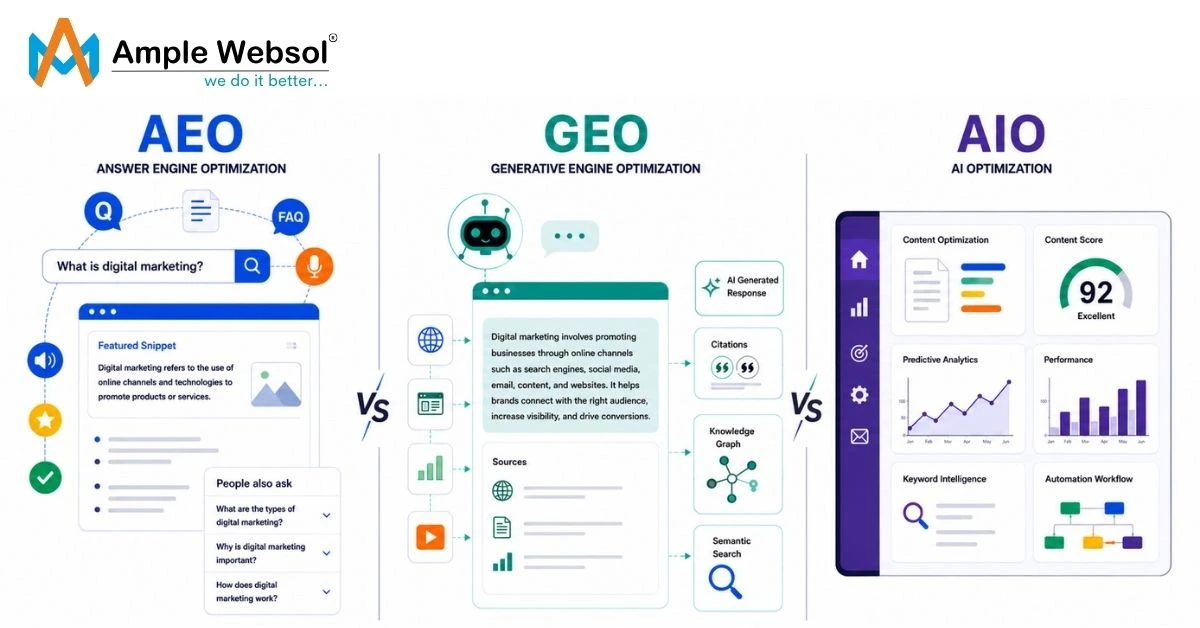
Although these terms are related, they have different focuses. AEO (Answer Engine Optimization) focuses on providing direct answers, GEO (Generative Engine Optimization) focuses on visibility in AI-generated responses, while AIO (AI Optimization) is commonly used as a broader term for improving visibility across AI-powered systems.
Understanding the difference between AEO, GEO, AIO, and SEO can help businesses create a stronger search visibility strategy for 2026 and beyond.
What Is AEO?
AEO stands for Answer Engine Optimization. It focuses on optimizing content so search engines and answer engines can easily understand and provide direct answers to users’ questions.
AEO is especially useful for question-based searches such as:
- What is SEO?
- How does ecommerce SEO work?
- What is website development?
- How much does SEO cost?
- How can I improve Google rankings?
AEO-friendly content usually provides a short, clear answer first and then explains the topic in greater detail.
What Is GEO?
GEO stands for Generative Engine Optimization. It focuses on improving the chances of a business, website, or content being referenced in AI-generated answers.
AI-powered search platforms can combine information from multiple sources to create a response. GEO focuses on creating useful, authoritative, and well-structured content that AI systems can understand and potentially reference.
Important GEO strategies include:
- Creating original and helpful content
- Building topical authority
- Providing accurate information
- Supporting claims with reliable sources
- Strengthening brand and entity information
- Earning relevant mentions and links
What Is AIO?
AIO commonly means AI Optimization. Unlike AEO and GEO, the term AIO does not have one universally accepted definition.
Generally, AIO refers to optimizing a website, content, brand information, and digital presence so AI-powered systems can better understand and discover the business.
AIO may include:
- AI-friendly content
- Structured information
- Brand optimization
- Entity optimization
- AI-assisted SEO
- Content optimization
- Digital reputation management
Because different agencies may use “AIO” differently, businesses should clarify exactly what an AIO service includes.
Want your business to be found on Google and AI-powered search? Contact Us today for SEO, AEO, and AI-focused strategies that help you grow online.
AEO vs GEO vs AIO
The easiest way to understand these three concepts is to compare their primary objectives.
| Feature | AEO | GEO | AIO |
| Full Form | Answer Engine Optimization | Generative Engine Optimization | AI Optimization |
| Main Goal | Provide direct answers | Improve visibility in AI-generated answers | Improve overall AI visibility |
| Main Focus | Questions and answers | Generative search | AI-powered discovery |
| Content Approach | Concise and answer-focused | Helpful, authoritative, contextual | Structured and AI-friendly |
| Common Platforms | Google Search, voice assistants | AI search and generative engines | AI-powered platforms |
| Key Opportunities | Featured snippets, FAQs, direct answers | AI citations and brand mentions | AI discovery and recommendations |
| Relationship with SEO | Supports SEO | Builds on SEO | Broader AI-focused approach |
How AEO, GEO and AIO Work Together?
Businesses don’t need three completely separate content strategies.
A better approach is to create high-quality content that supports SEO, AEO, GEO, and broader AI visibility at the same time.
For example, a blog about “Ecommerce SEO” can:
- Target the primary ecommerce SEO keyword.
- Provide a direct definition for AEO.
- Include detailed, authoritative information for GEO.
- Clearly explain the brand’s expertise for broader AI visibility.
- Use headings, tables, FAQs, and internal links for better usability.
This creates content that works for both people and modern search systems.
Does AEO, GEO or AIO Replace SEO?
No. SEO remains the foundation. AEO, GEO, and AIO should be viewed as additional strategies that support search and AI visibility.
Google recommends continuing to focus on fundamental SEO practices, including making content accessible to search engines and creating unique, helpful, reliable, people-first content.
A strong strategy can therefore be represented as:
SEO + AEO + GEO + AIO = Stronger Search & AI Visibility
Common Mistakes to Avoid
Businesses should avoid treating AEO, GEO, and AIO as shortcuts to rankings or AI visibility.
Common mistakes include:
- Creating low-quality AI-generated content
- Keyword stuffing
- Adding unnecessary FAQs
- Creating pages without search intent
- Publishing repetitive content
- Ignoring technical SEO
- Focusing only on AI search
- Using unreliable information
- Creating content only for search engines
Google’s guidance emphasizes creating helpful, original content rather than producing large volumes of content primarily to manipulate search rankings or AI responses.
AEO, GEO & AIO Strategy for Businesses
Businesses can start with a simple approach:
| Step | Action |
| 1 | Build a strong SEO foundation |
| 2 | Research customer questions |
| 3 | Create helpful answer-focused content |
| 4 | Build topical authority |
| 5 | Add relevant FAQs |
| 6 | Improve internal linking |
| 7 | Keep business information consistent |
| 8 | Add appropriate structured data |
| 9 | Build trusted industry mentions |
| 10 | Monitor search and AI visibility |
Frequently Asked Questions
AEO, or Answer Engine Optimization, focuses on creating content that directly answers user questions and makes information easier for answer engines and search systems to understand.
GEO, or Generative Engine Optimization, focuses on improving the visibility of content and brands within AI-generated search responses.
AIO commonly stands for AI Optimization. It is generally used to describe strategies designed to improve how AI-powered systems understand and discover a website, brand, or content.
None is universally better. Each serves a different purpose. A strong digital strategy combines traditional SEO with AEO, GEO, and relevant AI optimization practices.
No. GEO does not replace SEO. Strong technical SEO, useful content, website accessibility, and search visibility remain important foundations for AI-powered search.
Businesses should create original and helpful content, answer customer questions clearly, build topical authority, maintain accurate business information, improve technical SEO, and provide a strong user experience.
Conclusion
The difference between AEO, GEO, and AIO mainly comes down to their focus. AEO aims to provide direct answers, GEO focuses on visibility in generative AI responses, and AIO is a broader term for optimizing digital presence for AI-powered systems.
Businesses should not abandon traditional SEO while adopting these new approaches. Instead, combining SEO, AEO, GEO, and AIO can create a stronger strategy for reaching customers across traditional search and AI-powered discovery.
The future of search is becoming more conversational and AI-driven, but the fundamentals remain simple: create useful content, answer real questions, demonstrate expertise, and make your website easy for both users and search systems to understand.

Related Posts


